

Filtering removes candidates who don't qualify. Ranking orders the ones who do — so the best matches always appear at the top.
1. Filtering — who qualifies
Filtering is your must-have checklist. Only candidates who meet every mandatory criterion move forward to the ranking stage. If a candidate doesn't pass the filters, they won't appear in your results at all.

⚠️ Mandatory filters are strictI if a candidate doesn't meet even one mandatory filter, they are excluded entirely. Use them for true dealbreakers only — move everything else to "Nice to Have" to avoid shrinking your pool unnecessarily.
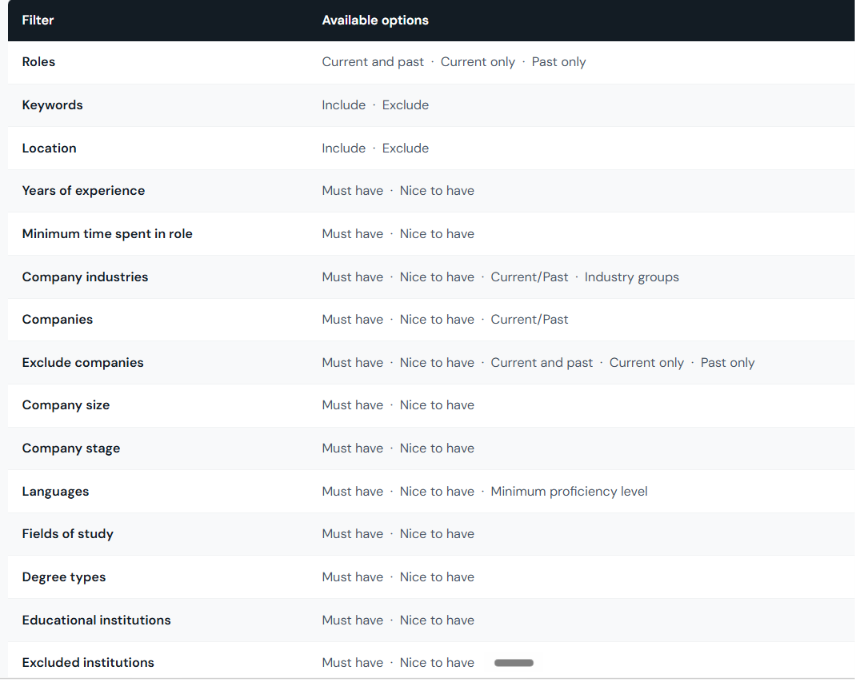
Filter options explained
Before diving into the full table, here's what each matching option means — you'll see these across different filters throughout the form.
Must have
Candidates must meet this requirement to appear in your results. If they don't, they're excluded entirely.
Nice to have
Treated as a preference. Candidates who meet it rank higher — but those who don't can still appear if they're a strong match otherwise.
Current only
Limits to candidates who currently hold that role or have that experience — not someone who had it in the past.
Include / Exclude
Include shows candidates who match the criterion. Exclude removes candidates who match it — useful for filtering out competitors or irrelevant backgrounds.
How each filter works
Ranking — who appears first
Once candidates pass the filters, Nova ranks them automatically. You can choose which ranking method works best for your search from the dropdown in the top right of your results.
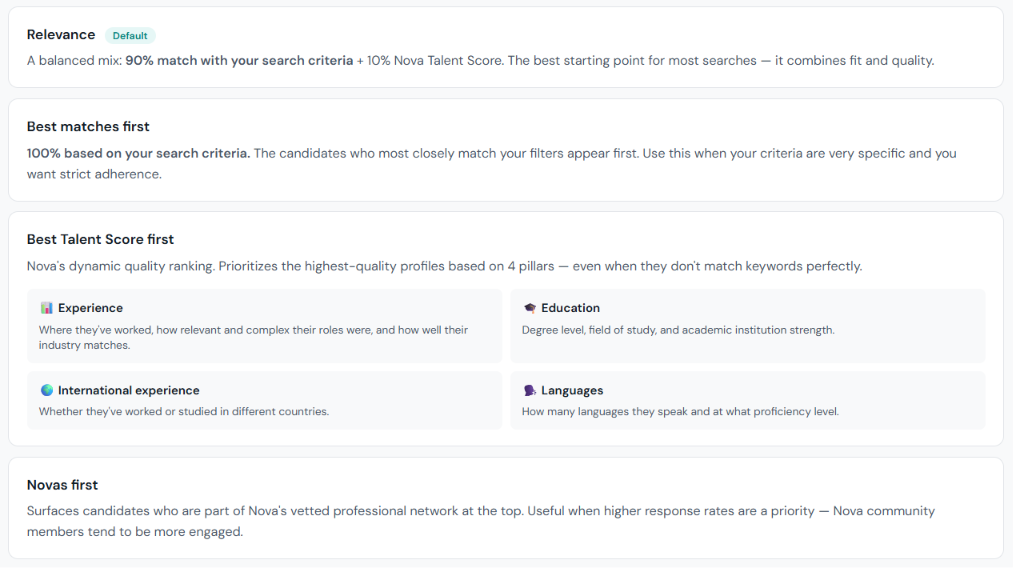
✨ Which ranking should you use?
Start with Relevance (default) for most searches. Switch to Best Talent Score when you want high-quality generalist candidates and keyword matching is less critical. Use Best matches first only when your criteria are very precise and non-negotiable.